
$ 6.00
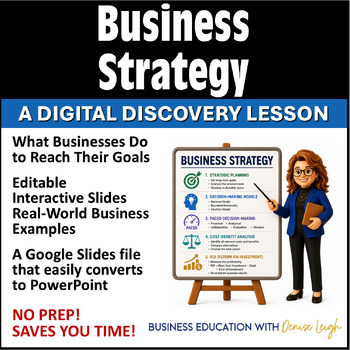
This engaging lesson introduces students to how businesses create strategies, make decisions, evaluate risks, and use data to guide business success. Students explore real-world business strategy concepts through recognizable brands like Nike, Starbucks, Dunkin’, TikTok, and Target while practicing critical-thinking and decision-making skills using the PACED Decision-Making Model.
Students will learn how businesses collect and analyze data, compare costs and benefits, evaluate ROI (Return on Investment), and develop strategies and tactics to reach company goals. The lesson includes interactive activities, real-world examples, discussion prompts, and decision-making practice scenarios that keep students actively involved and make complex business concepts easier to understand.
✅ Perfect for 9th, 10th, 11th, and 12th grades (High School) including homeschool

This engaging lesson introduces students to how businesses create strategies, make decisions, evaluate risks, and use data to guide business success. Students explore real-world business strategy concepts through recognizable brands like Nike, Starbucks, Dunkin’, TikTok, and Target while practicing critical-thinking and decision-making skills using the PACED Decision-Making Model.
Students will learn how businesses collect and analyze data, compare costs and benefits, evaluate ROI (Return on Investment), and develop strategies and tactics to reach company goals. The lesson includes interactive activities, real-world examples, discussion prompts, and decision-making practice scenarios that keep students actively involved and make complex business concepts easier to understand.
✅ Perfect for 9th, 10th, 11th, and 12th grades (High School) including homeschool
💯 Perfect For Teaching:
Business strategy
Strategic planning
Decision-making models
PACED decision-making
Cost-benefit analysis
ROI (Return on Investment)
Business data collection
Strategy vs. tactics
Business problem-solving
Critical-thinking and business analysis
Why Teachers Will ❤️ This Lesson
✔️ Ready-to-use — NO PREP required
✔️ Uses real-world companies students immediately recognize
✔️ Keeps students engaged with relatable business examples
✔️ Breaks down difficult business concepts into student-friendly language
✔️ Encourages classroom discussion and higher-level thinking
✔️ Includes interactive strategy and decision-making activities
✔️ Great for Business, Entrepreneurship, Marketing, and Personal Finance courses
✔️ Helps students connect classroom learning to real business decisions
What Students Will Learn❓
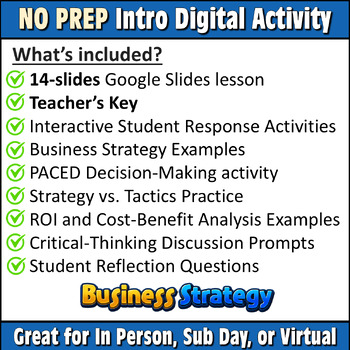
What’s Included❓
⏱ Teaching Duration: Approximately 45–60 minutes + discussion time
🎯 What Class Is This For?
AP Business w/ Personal Finance
Entrepreneurship
Introduction to Business / Business Essentials
Marketing
Business Management
CTE Business Courses
School Store
🧩 Student Activity Highlights
✔️ Analyze strategies used by major companies
✔️ Compare strategy vs. tactics
✔️ Practice business decision-making using PACED
✔️ Evaluate business risks and rewards
✔️ Discuss customer trends and business data
✔️ Identify costs, benefits, and ROI in business situations
✔️ Apply critical-thinking to real-world business problems
🏫 AP Business Alignment
This lesson aligns with:
4.3.A.1 Explain the purpose of business strategy and how businesses use strategy to achieve organizational goals.
4.3.A.2 Describe how businesses use internal and external data to support strategic planning and decision-making.
4.3.A.3 Explain the difference between long-term business strategy and short-term business tactics.
4.3.A.4 Analyze how businesses use strategic planning to respond to competition, customer needs, and market trends.
4.3.B.1 Explain how businesses use decision-making models to evaluate alternatives and solve problems.
4.3.B.2 Describe how businesses compare costs and benefits when making decisions.
4.3.B.3 Explain how businesses evaluate risks and rewards before making strategic decisions.
4.3.B.4 Analyze how businesses use ROI (Return on Investment) to evaluate business opportunities and spending decisions.
4.3.B.5 Explain why businesses sometimes must make decisions using limited or incomplete information.
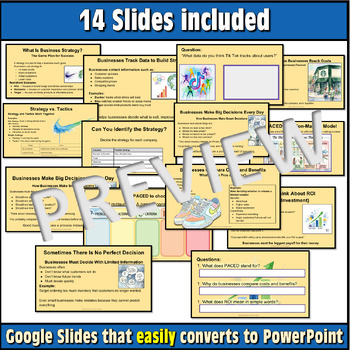
📥 File Type: Google Slides (Editable + easily converts to PowerPoint)
🎯 This lesson is a great way to introduce students to business strategy and decision-making while helping them build critical-thinking, analytical reasoning, and real-world business skills they can apply in future careers, entrepreneurship, and everyday life.
Only logged in customers who have purchased this product may leave a review.

Reviews
There are no reviews yet.