
$ 30.00
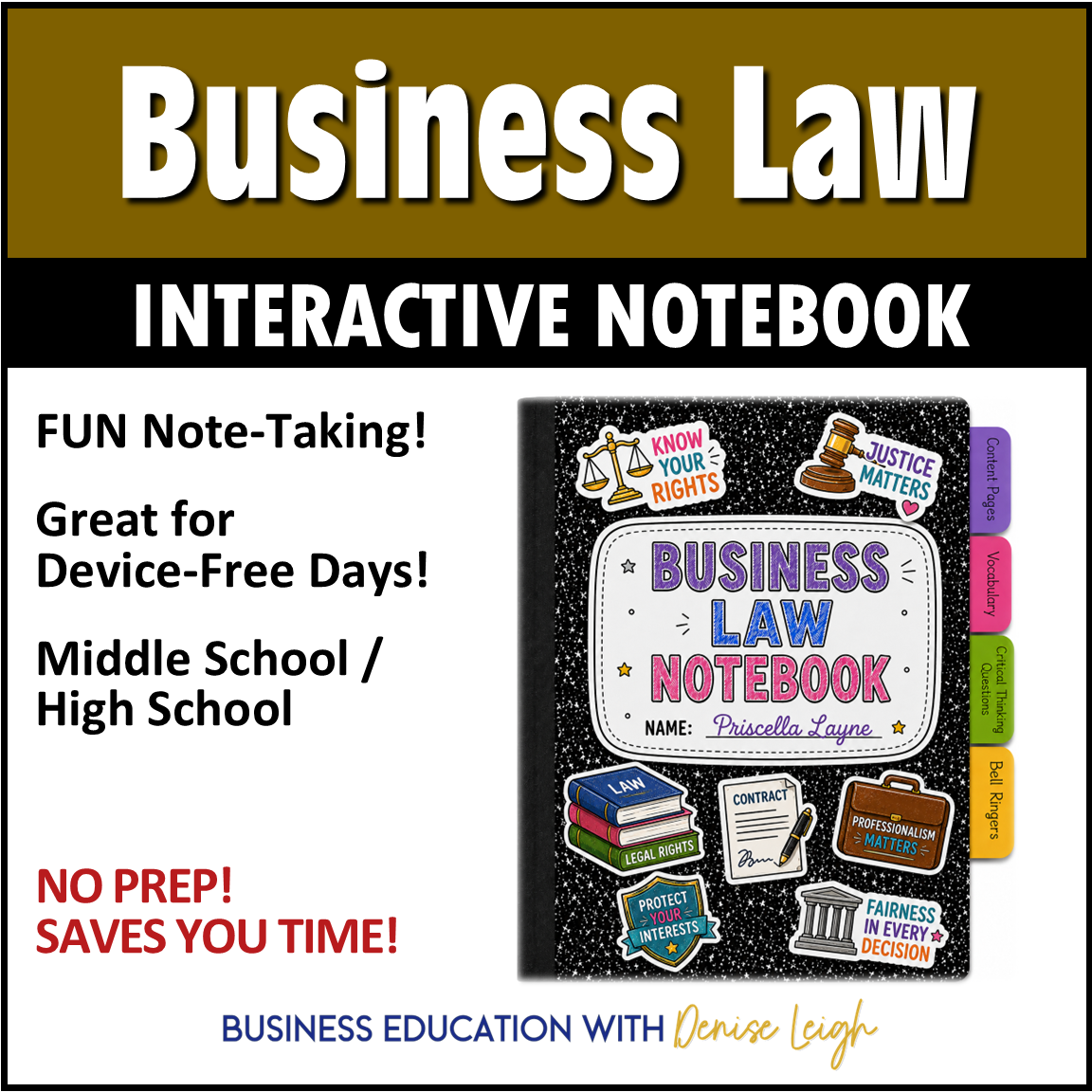
Give your students a fun, organized, and meaningful way to learn Business Law while getting them off their devices! My Business Law Interactive Notebook helps students actively engage with essential legal concepts through structured note-taking, vocabulary development, critical-thinking questions, real-world applications, and bell ringers.
Instead of simply copying definitions or listening to lectures, students create a personalized Business Law notebook that becomes both a study guide and a valuable classroom reference.
This printable resource is designed for middle school and high school students and works well in Business Law, Introduction to Business, Business Foundations, Entrepreneurship, Career Readiness, Consumer Education, and other CTE Business courses.
✅ Perfect for 6th, 7th, 8th, 9th, 10th, 11th, and 12th grades (Middle School & High School)

Business Law Interactive Notebook | Guided Notes, Vocabulary & Bell Ringers
Give your students a fun, organized, and meaningful way to learn Business Law while getting them off their devices! My Business Law Interactive Notebook helps students actively engage with essential legal concepts through structured note-taking, vocabulary development, critical-thinking questions, real-world applications, and bell ringers.
Instead of simply copying definitions or listening to lectures, students create a personalized Business Law notebook that becomes both a study guide and a valuable classroom reference.
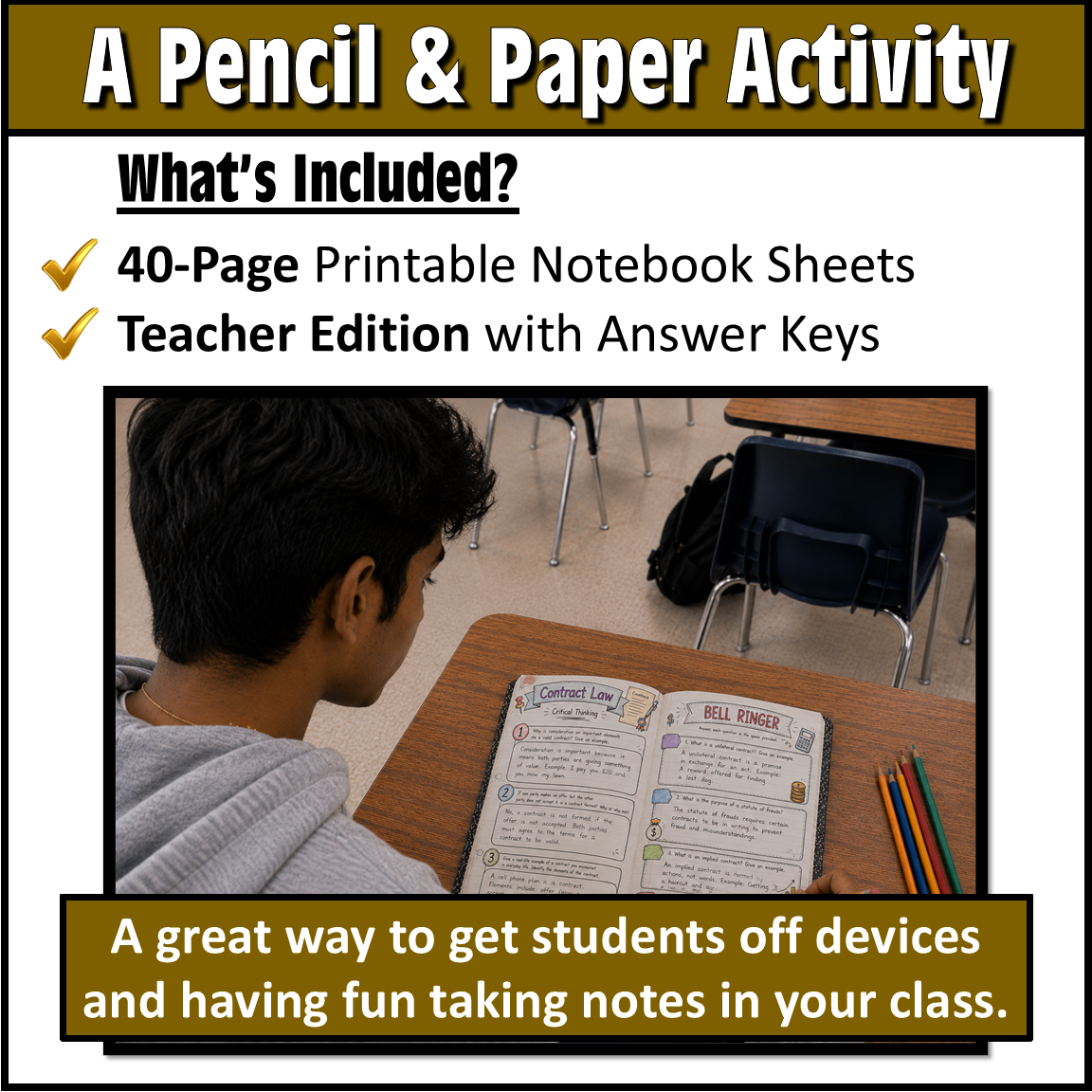
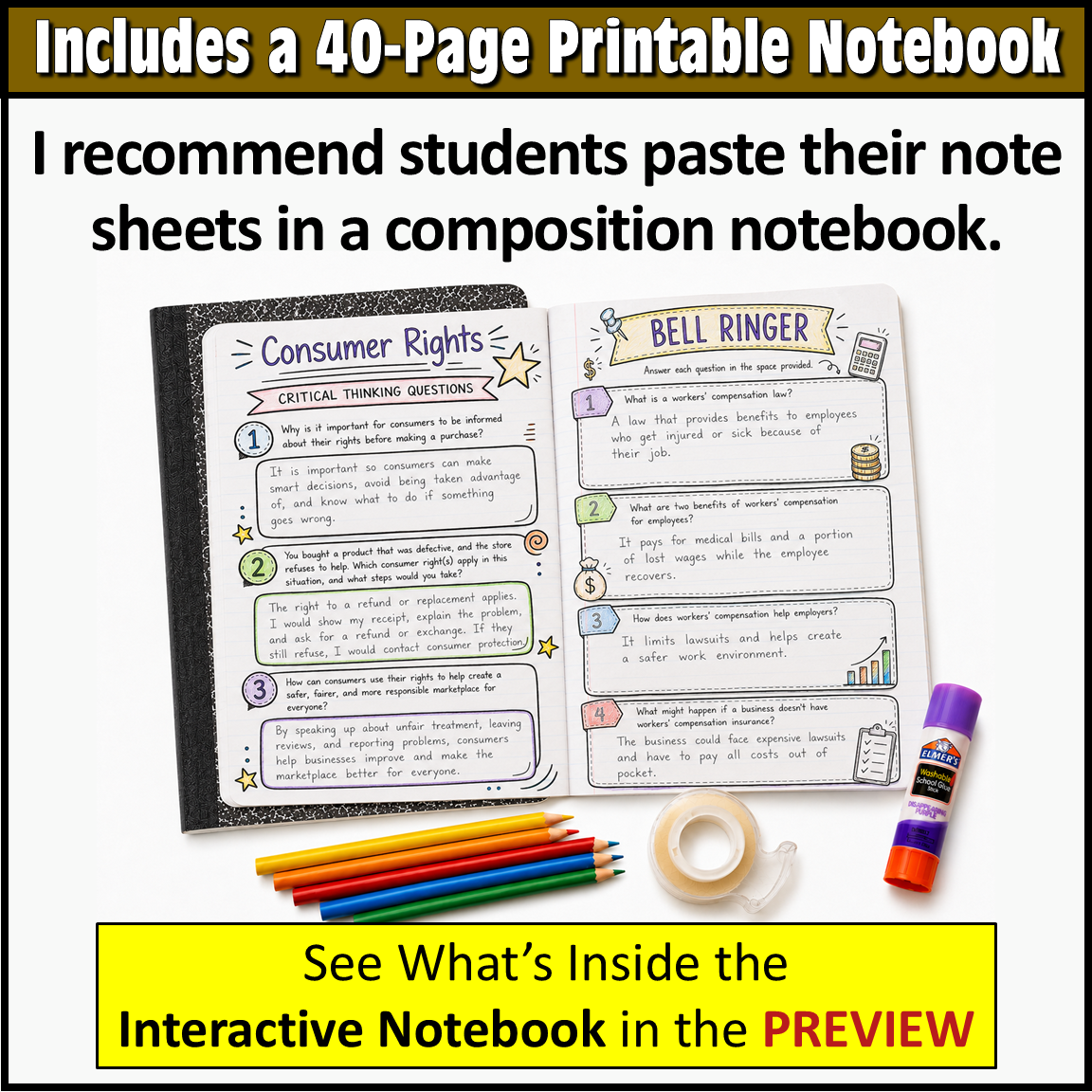
Students can color the pages, tape or glue them into a composition notebook, write vocabulary definitions on the opposite notebook page, and respond to open-ended questions that require them to analyze legal concepts and apply what they have learned to realistic business, consumer, employment, and courtroom situations.
This printable resource is designed for middle school and high school students and works well in Business Law, Introduction to Business, Business Foundations, Entrepreneurship, Career Readiness, Consumer Education, and other CTE Business courses.
✅ Perfect for 6th, 7th, 8th, 9th, 10th, 11th, and 12th grades (Middle School & High School)
Why Teachers Will ❤️ This Interactive Notebook
✔️ NO PREP—Simply print and use
✔️ Gives students a structured way to organize Business Law concepts
✔️ Provides a meaningful technology-free learning option
✔️ Encourages writing, reflection, analysis, and active note-taking
✔️ Reinforces essential Business Law vocabulary
✔️ Connects legal concepts to real-world business and consumer situations
✔️ Includes critical-thinking questions for major topics
✔️ Includes bell-ringer and exit-ticket questions
✔️ Works as guided notes, independent practice, review, or assessment
✔️ Creates a student-made Business Law study guide
✔️ Includes a completed Teacher Edition for the content pages
✔️ Includes teacher instructions and grading suggestions
✔️ Great for in-person learning, homeschool, review days, and substitute plans
✔️ Perfect for new Business teachers, veteran teachers, and multiple-prep teachers
What’s Included❓
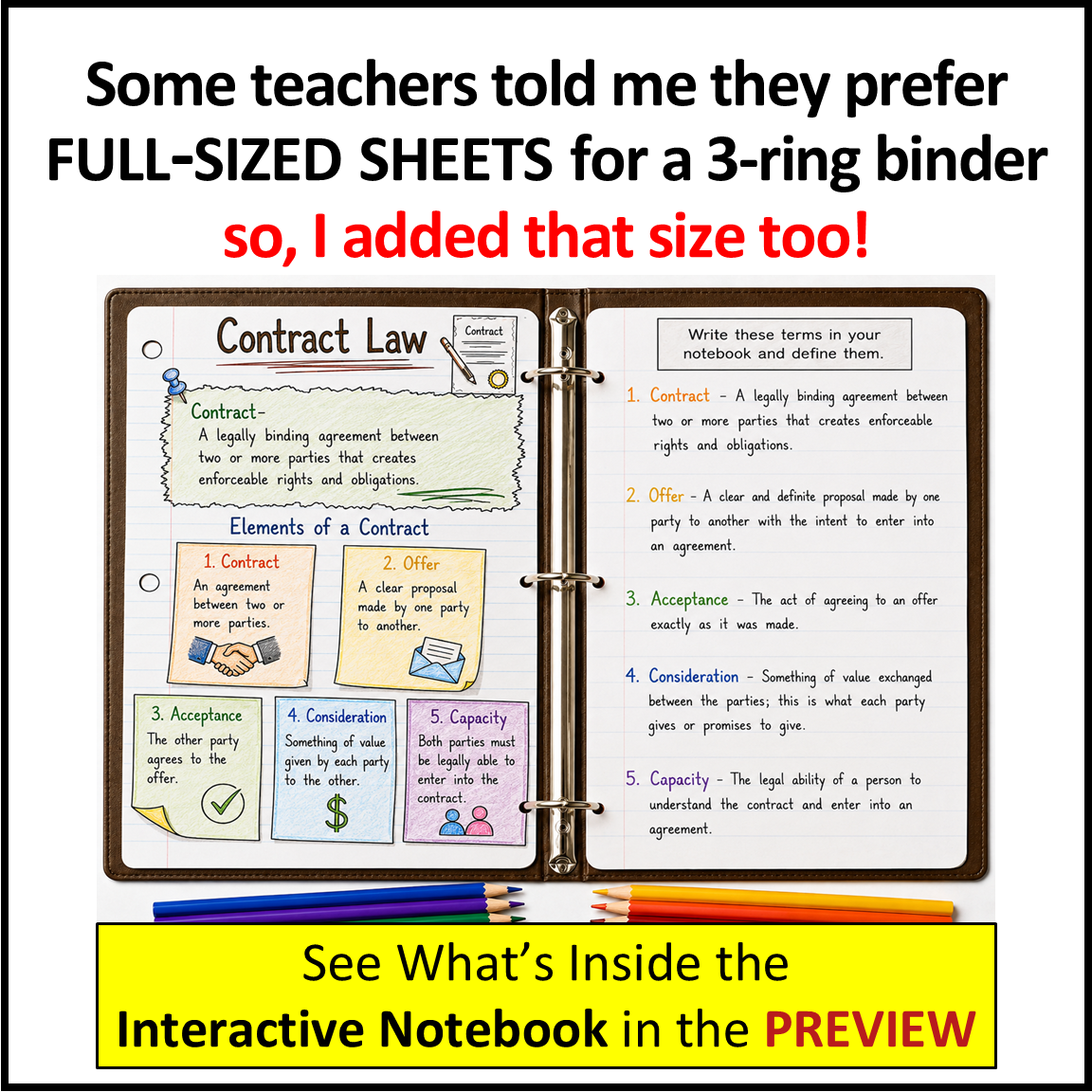
The resource includes pages designed for a traditional interactive notebook as well as full-size 8.5″ × 11″ sheets for teachers who prefer students to keep their work in a 3-ring binder.
🎯 How the Interactive Notebook Works
Each major topic follows a consistent three-part format:
1. Content Page
Students complete an illustrated content page that organizes and summarizes the major legal concepts. The page can be colored, completed, and attached to a composition notebook using tape or a glue stick.
I recommend projecting the completed Teacher Edition so students can accurately complete their notes while you teach or discuss the topic.
2. Vocabulary Connection
Students write the accompanying Business Law vocabulary terms on the opposite notebook page and define or explain each term.
This helps students build a strong working legal vocabulary while connecting important terminology to the lesson content.
3. Critical-Thinking Questions
Students apply what they learned through open-ended questions, legal scenarios, comparisons, personal reflections, research, and real-world applications.
4. Bell Ringers & Exit Tickets
The notebook also includes bell-ringer pages. A complete collection of suggested bell-ringer and exit-ticket questions is provided in the Teacher Edition. Teachers can write one question on the board and have students respond directly on the notebook’s bell-ringer pages.
These activities work well as:
✔️ Independent work
✔️ Technology-Free learning activities
✔️ Guided notes
✔️ Bell ringers
✔️ Exit tickets
✔️ Homework
✔️ Formative assessments
✔️ Review activities
✔️ Substitute plans
💯 What Class Is This For?
📥 File Type: Printable Google Slides files (or convert to pdf or PowerPoint).
Students may use the pages in:
✔️ A composition notebook
OR
✔️ A 3-ring binder using the included full-size sheets
It is not an editable digital notebook.
⭐Perfect for Device-Free Days⭐
What Students Will Learn❓
Goals and Purposes of Law
Students examine why laws are necessary and how legal systems help societies:
Important vocabulary includes:
Students apply these ideas by considering how society would function without laws and evaluating which goals of law are most important.
Civil Law and Criminal Law
Students compare the two major kinds of law and examine how each protects individuals and society.
Topics include:
Students evaluate situations that may involve both criminal and civil cases and consider whether legal penalties are fair and appropriate.
Parties in a Lawsuit
Students learn the roles and responsibilities of the parties involved in a lawsuit.
Topics and vocabulary include:
Students examine who begins a lawsuit, who must respond, what each party claims, and what legal relief or compensation may be requested.
Steps in a Trial
Students organize and examine the major stages of a courtroom trial, including:
Important vocabulary includes:
Students consider how testimony is evaluated, why both sides must present their cases, and how jurors use evidence to reach a fair decision.
Contract Law
Students learn what makes an agreement legally enforceable and why contracts are important to individuals and businesses.
Topics include:
Students identify the essential elements of a valid contract and apply those elements to agreements they encounter in everyday life.
Breach of Contract and Legal Remedies
Students examine what happens when one party fails to fulfill a contractual obligation.
Topics include:
Students compare the major remedies for breach of contract and determine which remedy may be most appropriate in different situations.
Warranties
Students learn how warranties protect consumers and affect relationships between buyers and sellers.
Topics include:
Students compare express and implied warranties and evaluate how disclaimers may influence a consumer’s purchasing decision.
Express Warranties
Students take a closer look at legally stated product promises.
Topics include:
Students examine the protections provided by written warranties and how businesses may be required to repair, replace, or refund defective products.
Implied Warranties and Product Liability
Students explore warranties that may exist even when they are not written or directly stated.
Topics include:
Students analyze how implied warranties protect consumers and why manufacturers and sellers may be held responsible for unsafe or defective products.
Antitrust Laws and Competition
Students examine how laws promote fair competition and prevent businesses from gaining excessive control over a market.
Topics include:
Students evaluate why monopolies may harm consumers and how competition can influence prices, choices, innovation, and product quality.
Intellectual Property
Students learn how businesses and creators legally protect original ideas, inventions, products, and creative work.
Topics include:
Students consider why creators deserve legal protection and how intellectual property laws encourage innovation and responsible business practices.
Branches of Law
Students explore the different areas of law that influence individuals, governments, businesses, and communities.
Important vocabulary includes:
Students compare branches of law and determine which areas may apply to crimes, private disputes, business practices, government decisions, property, and the environment.
Workers’ Compensation
Students examine how workers’ compensation laws protect employees who experience job-related injuries or illnesses.
Topics include:
Students evaluate how workers’ compensation benefits both employees and employers and consider the consequences of operating a business without appropriate coverage.
Consumer Rights
Students learn about the legal protections available to consumers when purchasing products and services.
Topics include:
Students apply these rights to situations involving defective products, misleading advertisements, unsafe products, and denied refunds.
Tort Law
Students examine wrongful acts that may result in civil liability.
Topics include:
Students analyze how tort laws protect society and why people and businesses may be held legally responsible for injuries or damages they cause.
Migrant and Seasonal Agricultural Workers
Students examine workplace protections provided to migrant and seasonal agricultural employees.
Topics include:
Students evaluate why certain workers may require additional protections and how labor laws establish safer and fairer working conditions.
Uniform Commercial Code
Students are introduced to the purpose and organization of the Uniform Commercial Code, including its nine major articles.
Topics include:
Students consider why businesses benefit from having consistent commercial rules across states.
Employment Law
Students examine laws and workplace policies that affect employers and employees.
Topics include:
Students consider how employment laws create fairer workplaces and help employers establish consistent policies and procedures.
White-Collar Crimes
Students learn about nonviolent crimes that are commonly committed for financial gain.
Topics include:
Students analyze why white-collar crimes can cause serious financial harm even when physical violence is not involved.
The notebook also includes a research activity in which students identify and describe additional types of white-collar crime.
Legally Protecting a Small Business
Students examine practical steps entrepreneurs can take to reduce legal risk and protect a new business.
Topics include:
Students evaluate which legal protections are most important when starting and operating a small business.
🎯 This Business Law Interactive Notebook gives students a creative and structured way to interact with legal content while developing vocabulary, critical-thinking skills, consumer awareness, workplace knowledge, and practical business understanding.
By the end of the course, students will have created a personalized Business Law reference notebook they can use to review concepts, prepare for assessments, and connect classroom learning to real-world businesses, consumers, employees, contracts, courts, and legal decisions.
My Business Law Interactive Notebook makes an excellent companion to my Business Law Semester Course.
Only logged in customers who have purchased this product may leave a review.

Reviews
There are no reviews yet.