
$ 6.00 $ 4.50 25%
Four Types of Income | Financial Literacy Lesson | Career Readiness & Compensation Analysis
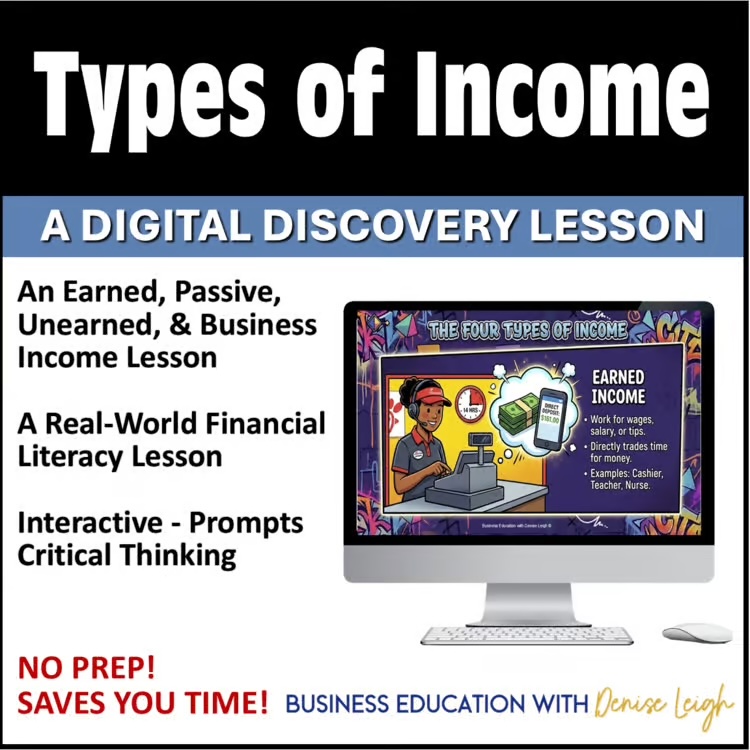
Understanding how money is earned is foundational to financial literacy. This ready-to-use lesson teaches students the four types of income—earned income, business income, unearned (portfolio) income, and passive income— and challenges them to apply that knowledge to real-world career and compensation scenarios.
This is more than a vocabulary lesson. Students analyze job offers, evaluate benefits packages, and explore the long-term impact of financial decisions like 401k matching and salary negotiation.

Four Types of Income | Financial Literacy Lesson | Career Readiness & Compensation Analysis
Understanding how money is earned is foundational to financial literacy. This ready-to-use lesson teaches students the four types of income—earned income, business income, unearned (portfolio) income, and passive income— and challenges them to apply that knowledge to real-world career and compensation scenarios.
This is more than a vocabulary lesson. Students analyze job offers, evaluate benefits packages, and explore the long-term impact of financial decisions like 401k matching and salary negotiation.
What’s Included❓
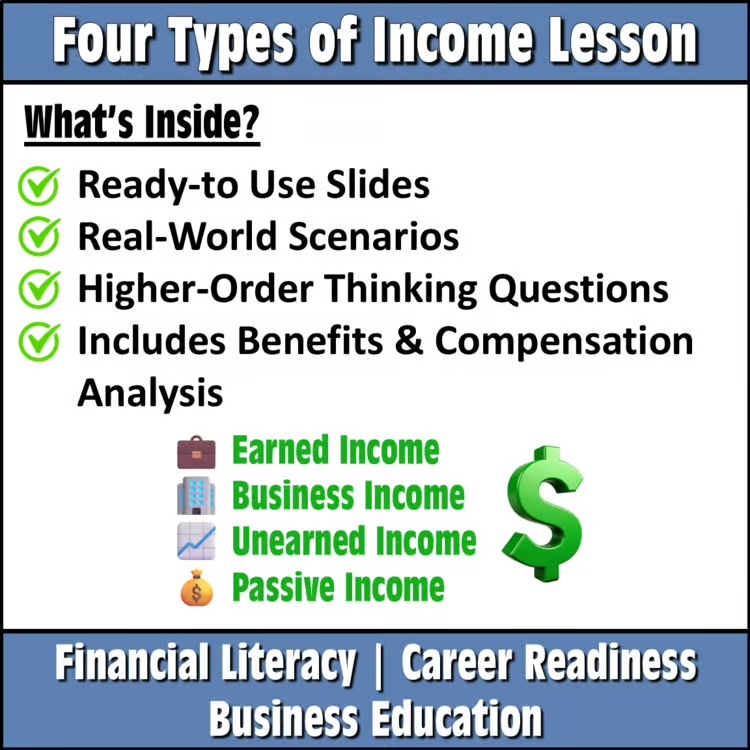
✔️ Instructional slides introducing and explaining the four types of income
✔️ 20 interactive slides in Google Slides format (or EASILY converts to Microsoft PowerPoint)
✔️ Real-world examples and guided explanations
✔️ Scenario-based classification practice
✔️ Higher-order discussion prompts
✔️ Compensation and benefits analysis questions
✔️ 401k matching and long-term financial thinking applications
This resource is designed for direct instruction, guided practice, and meaningful classroom discussion.
🎯 Learning Objectives
Students will:
📚 What Class Is This For?
This resource is designed for use in:
It is especially aligned to (see full standards below):
💯Skills & Standards Alignment
This lesson supports:
Students practice economic reasoning while building real-world financial awareness.
Why Teachers Will ❤️ This Resource
✔️ Easy-to-implement, ready-to-teach format
✔️ Promotes real-world financial literacy
✔️ Encourages higher-order thinking and discussion
✔️ Connects directly to career readiness
✔️ Engaging and practical for middle and high school students
This lesson works well as:
💡Classroom Use Ideas
🎯Grade Levels
✅ Perfect for 9th, 10th, 11th, and 12th grades (High School) including homeschooling
⭐Aligned with Pennsylvania Academic Standards for Personal Finance ⭐
(22 Pa. Code Chapter 4, Appendix F)
17.2 Income – Sources of Income (Grades 9–12)
17.2.9-12.A – “Explain various types of income (e.g., earned, unearned, passive, active) and their sources (e.g., work, rentals, investments, government programs).”
17.2 Income – Employee Benefits (Grades 9–12)
17.2.9-12.F – “Explain the impact of employee benefits (e.g., health insurance, retirement savings plans, education reimbursement programs) on an individual’s finances.”
17.2 Income – Self-Employment (Grades 9–12)
17.2.9-12.G – “Analyze the financial impact of a person’s decision to own a business, work as an independent contractor, or be employed.”
17.1 Personal Finance Fundamentals (Grades 9–12)
17.1.9-12.B – “Apply a systematic decision-making process, including opportunity costs, to setting and achieving financial goals.”
⭐Texas TEKS Personal Financial Literacy and Economics §113.76 ⭐
(4) Personal Financial Literacy – Earning
(4)(A) – “Identify sources of income, including wages and salaries, profits, interest, rent, dividends, and capital gains.”
This standard directly aligns with your four income types instruction.
(4)(B) – “Compare common employee benefits such as health insurance, sick leave, retirement plans, and other tax-favored health and dependent care plans.”
Your benefits and 401k match analysis addresses this precisely.
(5) Personal Financial Literacy – Entrepreneurship
(5)(B) – “Explain how an entrepreneur earns income, including through profits from the creation or ownership of businesses.”
Your business income section directly aligns.
(5)(C) – “Compare total compensation, additional benefits, and obligations as a self-employed or independent contractor and as an employee.”
Your job comparison and compensation analysis align strongly here.
(6) Personal Financial Literacy – Spending
(6)(B) – “Analyze the opportunity costs of spending and saving in recognizing short-, medium-, and long-term goals.”
(10) Personal Financial Literacy Skills
(10)(A) – “Use problem-solving and decision-making processes to identify a problem, gather information, list and consider options, consider advantages and disadvantages, choose and implement a solution, and evaluate the effectiveness of the solution.”
Only logged in customers who have purchased this product may leave a review.


Reviews
There are no reviews yet.