Description
Texas Entrepreneurship I Curriculum | TEKS §127.275 Full-Year Course
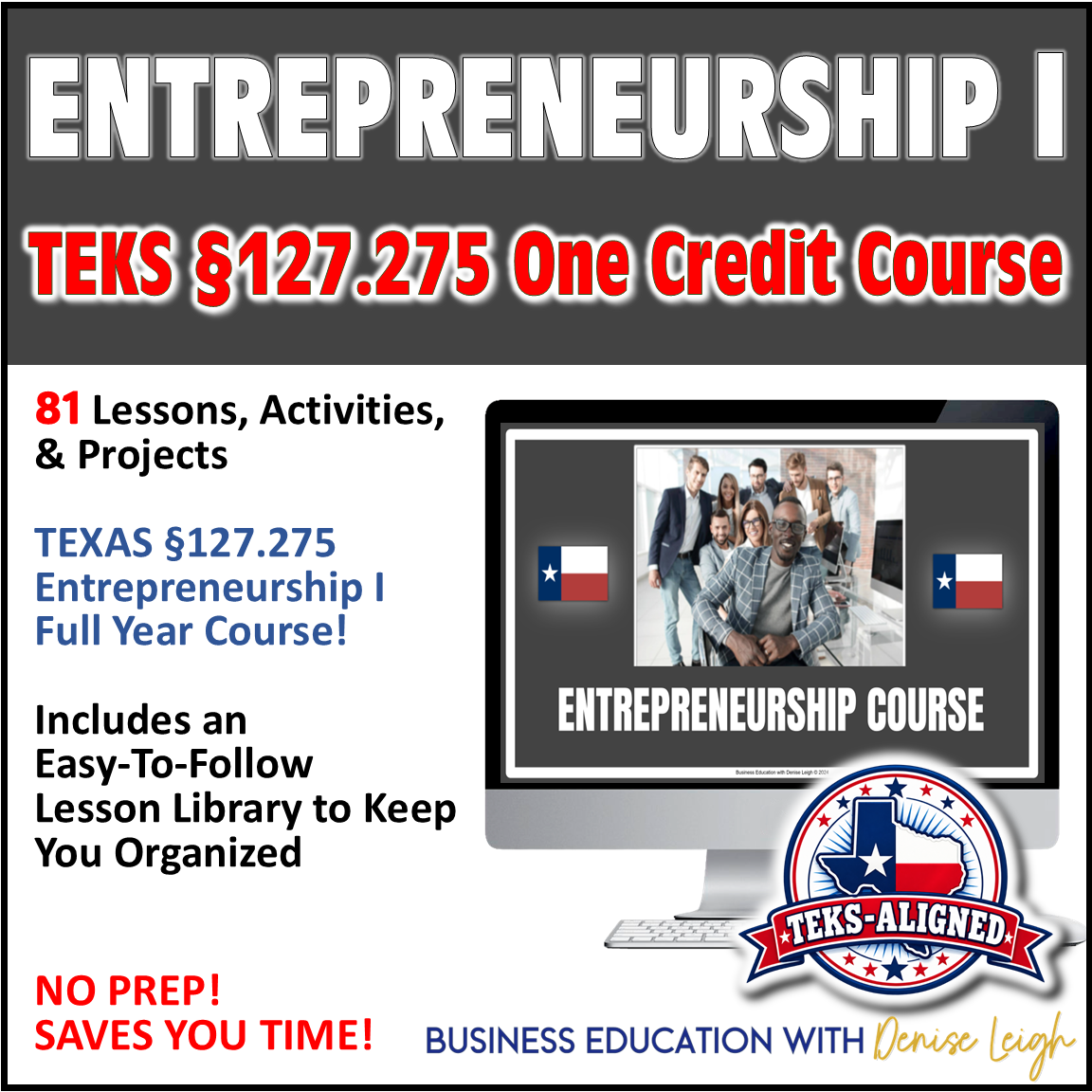
Teach Texas Entrepreneurship I with confidence using this complete full-year, one-credit Entrepreneurship curriculum aligned to TEKS §127.275.
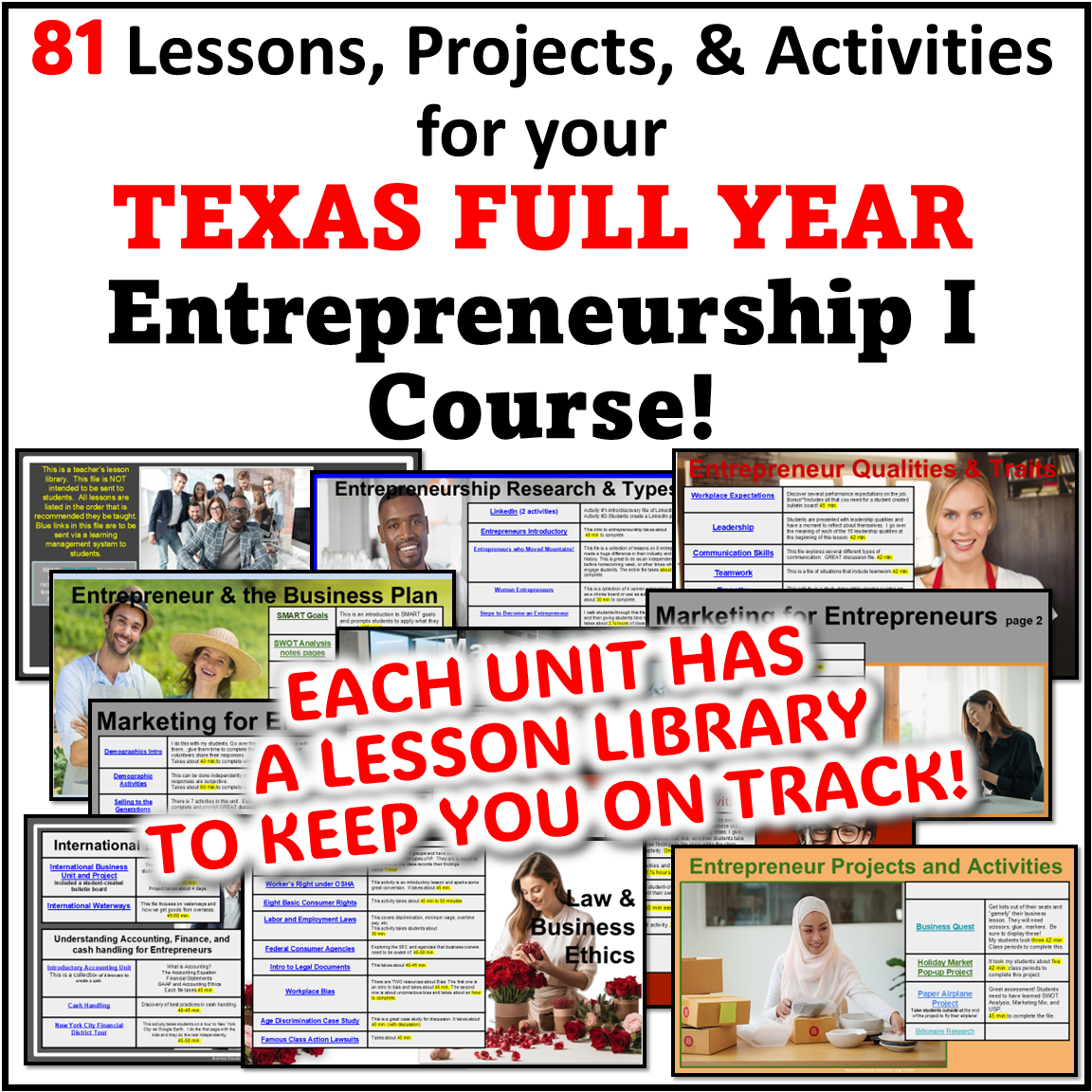
This comprehensive whole year Entrepreneurship course includes 81 lessons, activities, and projects organized into a complete instructional sequence for Texas high school Entrepreneurship I teachers.
✅Perfect for new(er) teachers or veteran teachers looking to freshen up their curriculum.
Students move from understanding entrepreneurs, entrepreneurial traits, business ownership, and startup funding into management, business planning, marketing, business law, ethics, international business, accounting, finance, cash handling, human resources, inventory management, and hands-on entrepreneurship projects.
⭐ NO PREP! NO GUESSWORK! SAVES YOU TIME!

One of the most valuable parts of this course is the included Teacher Lesson Library, which keeps your entire Entrepreneurship course organized. Lessons are listed in the order I recommend teaching them, with direct resource links, estimated teaching times, Teacher’s Keys and student examples where appropriate, instructional notes, teacher tips, and TEKS §127.275 standards cross-walked throughout the library.
Instead of wondering what you are going to teach tomorrow, open the Lesson Library, follow the sequence, click the lesson, and teach!
✅ Perfect for 9th, 10th, 11th, and 12th grades (High School)
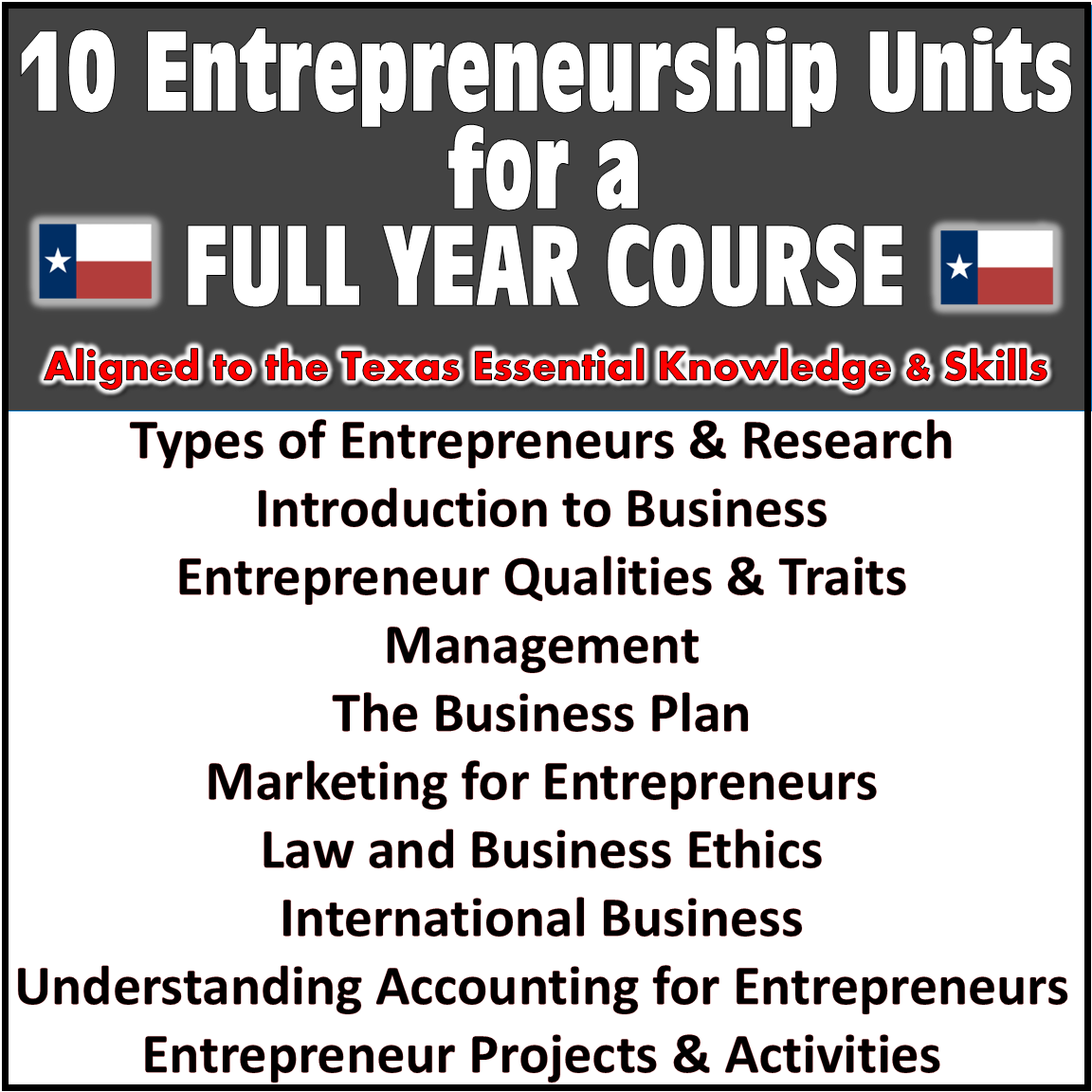
There are TEN (10) Entrepreneurial Units
- Type of Entrepreneurs & Entrepreneurs Research
- Introduction to Business
- Entrepreneur Qualities & Traits
- Management
- The Business Plan
- Marketing for Entrepreneurs
- Law and Business Ethics
- International Business
- Understanding Accounting for Entrepreneurs
- Entrepreneur Projects & Activities (including a Food Truck Capstone/Final project)
What’s Included❓
- Full-Year Texas Entrepreneurship I – One Credit Curriculum
- 81 Lessons, Activities, & Projects
- Teacher Lesson Library
- Recommended Teaching Sequence
- Estimated Pacing / Teaching Times
- TEKS §127.275 Standards Crosswalk
- Editable Course Syllabus
- Teacher Notes, Tips, and Suggestions
- Teacher’s Keys where appropriate
- Student Examples, where appropriate
- Interactive Google Slides and Google Docs activities
- Collaborative Activities
- Research Activities
- Business Case Studies
- Business Plan Project
- Marketing Projects
- Entrepreneurship Projects
- Capstone / Final Assessment
- Bell Ringers and Exit Tickets
- Student-Created Bulletin Board Activities
- Entrepreneurship Classroom Décor
Here is a short▶️video preview of my original Entrepreneurship Course. This TEKS course is laid out the same as my original Entrepreneurship course, except m TEKS Entrepreneurship I course includes a Business Management Unit.
Why Texas Teachers Will ❤️ This Entrepreneurship 1 Curriculum
✔️ Aligned with Texas Entrepreneurship I — TEKS §127.275
✔️ Complete one-credit, full-year, high school Entrepreneurship I course
✔️ 81 lessons, activities, and projects to cover the whole year
✔️ Organized into 10 Major Entrepreneurship units
✔️ Easy-to-follow Teacher Lesson Library
✔️ Lessons arranged in my recommended instructional sequence
✔️ Estimated teaching duration provided for lessons and activities
✔️ TEKS §127.275 cross-walked throughout the Lesson Library
✔️ Editable syllabus included
✔️ Teacher’s Keys included where appropriate
✔️ Student examples included with selected activities
✔️ Real-world Entrepreneurship applications
✔️ Individual and collaborative learning opportunities
✔️ Critical-thinking and reflection activities
✔️ Business case studies
✔️ Student-created bulletin boards and classroom displays
✔️ Business Plan Project included
✔️ Multiple Entrepreneurship projects and assessments
✔️ Food Truck Capstone Project included as a final assessment
✔️ Bell ringers and exit ticket writing prompts included
✔️ Google-based resources that easily convert to Microsoft formats
✔️ Perfect for new teachers, veteran teachers, and multiple-prep teachers
**All resource links are flattened, so students CANNOT copy and paste their answers. Students must use their critical thinking skills and build on their knowledge in order to complete the prompts.**
✅Teacher’s Keys Included (where appropriate).
⚠️SPECIAL BONUS: When buying this bundle, you receive the easy-to-follow LESSON LIBRARY for EVERY UNIT! The lesson libraries are a valuable tool for the teacher that lists all lessons in the order of instruction, links to the lesson, videos, teaching duration, and teacher’s keys!
**NO GUESS WORK! NO PREP! SAVE TIME**
MOST OF THESE LESSONS ARE ALSO PERFECT FOR SUB DAYS OR ONLINE INSTRUCTION DAYS! …which is great if you every have to miss a day of school.
10 Units Included:
✅Unit 1 – Types of Entrepreneurs & Entrepreneur Research Unit
- LinkedIn (2 Activities)
- Entrepreneurs Introductory
- Entrepreneurs Who Moved Mountains
- Women Entrepreneurs
- Steps to Become an Entrepreneur
- Different Type of Entrepreneurs
- Entrepreneurial Traits (not sold separately)
✅Unit 2 -Introduction to Business Unit
- Types of Businesses Industries
- Types of Business Ownership
- Supply and Demand
- Financial Capital for a Startup
- Sources of Business Capital
- Six Stages of the Buying Process
✅Unit 3 -Entrepreneur Qualities & Traits Unit
- Workplace Expectations
- Leadership Qualities
- Communication Soft Skills
- Teamwork
- Empathy
- Time Management
- Traits Self-Assessment
- Employability – Self Reflection
✅Unit 4 -Management
- Planning as a Management Function
- Organizing as a Management Function
- Organization Collaborative Slideshow/Bulletin Board (not sold separately) – a formative assessment.
- Leading as a Management Function
- Strategies for Effective Management of People at Work
- Controlling as a Management Function
✅Unit 5 -Entrepreneurship & the Business Plan Unit
- SMART Goals
- SWOT Analysis Notes
- SWOT Analysis Application
- Pest Analysis
- The Business Plan
✅Unit 6 -Marketing for Entrepreneurs Unit
- Marketing Demographics Introduction (not sold separately)
- Marketing Demographic Activities
- Selling to the Generations
- Google Ads
- Promotional Marketing
- Introduction to Social Media Marketing Platforms
- Social Media Gallery Walks
- Why People Buy
- Colors and Brands
- Marketing Segmentation
- Boardwalk Business Activitiy File
- Consumer Behavior and Their Fans
- Writing Prompts
- Writing Prompts
- Writing Prompts
✅ Unit 7 -Law & Business Ethics Unit
- Social Responsibility
- Intellectual Property
- Worker’s Rights Under OSHA
- Eight Basic Consumer Rights
- Consumer Law and the Federal Trade Commisssion (FTC)
- Labor and Employment Laws
- Federal Consumer Agencies
- Intro to Legal Documents
- Workplace Bias
- Age Discrimination Case Study
- Famous Class Action Lawsuits
✅Unit 8 -International Business Unit
- International Business Unit and Project
- International Waterways Activity
✅Unit 9 -Understanding Accounting, Finance, and Cash Handling
- Introduction to Accounting Unit
- Financial Statement Analysis
- Cash Handling
- New York City Financial District Tour
✅Unit 10 -Entrepreneur Projects and Activities
- Customer Service
- Earth Day
- Business Co-Op
- Human Resources
- Inventory Management
- Marketing Writing Prompts
- Business Quest ‘Game’
- Holiday Markets Pop-Up Project
- Paper Airplane Project
- Billionaire Research Activity
- Entrepreneur Capstone Project – Food Truck Project
✅BONUS – Entrepreneur Bulletin Board/Classroom Decor
PRINT → CUT → HANG!
🎯 Entrepreneurship Topics Covered
Students develop knowledge and skills in:
- Entrepreneurship Fundamentals — entrepreneurship, entrepreneurs, intrapreneurship, risks and rewards, innovation, and Entrepreneurship’s role in the economy.
- Types of Entrepreneurs — multiple routes and forms of Entrepreneurship, entrepreneurial career paths, and successful entrepreneurs.
- Entrepreneurial Traits & Self-Assessment — leadership, work ethic, communication, teamwork, empathy, time management, strengths, weaknesses, and opportunities for growth.
- Business Ownership & Industries — types of businesses, corporations, LLCs, franchises, partnerships, sole proprietorships, business structures, liability, control, and ownership.
- Economics & Consumer Behavior — supply, demand, consumer buying behavior, and marketplace decision-making.
- Startup Funding & Capital — startup costs, operating expenses, loans, grants, bootstrapping, crowdfunding, investors, equity financing, and venture capital.
- Management — planning, organizing, leading, controlling, management strategies, leadership, and managing people.
- Strategic Business Planning — SMART goals, SWOT Analysis, PEST Analysis, feasibility, strategic thinking, and business plans.
- Marketing — demographics, consumer behavior, market segmentation, generations, branding, promotion, Google Ads, digital marketing, social media, and target markets.
- Business Law & Ethics — intellectual property, consumer laws, OSHA, labor laws, employment law, discrimination, workplace bias, legal documents, government agencies, ethics, and social responsibility.
- International Business — globalization, international commerce, ports, waterways, distribution, and movement of goods.
- Accounting & Business Finance — accounting fundamentals, the accounting equation, GAAP, financial statements, revenue, expenses, assets, liabilities, equity, profitability, cash flow, and financial decision-making.
- Cash Handling & Internal Business Practices — protecting business cash and understanding responsible cash-management practices.
- Customer Service — customer-service standards and behaviors entrepreneurs need to build strong customer relationships.
- Human Resources & Employees — workplace expectations, HR concepts, compensation, management, and employee relationships.
- Inventory Management — managing products, supplies, inventory, and business resources.
- Entrepreneurship Research & Careers — entrepreneurs, CEOs, business leaders, career exploration, and professional networking.
- Business Communication — professional communication, presentations, collaboration, reflection, business writing, and discussion.
- Entrepreneurship Projects & Applications — students apply concepts through business simulations, collaborative assignments, research, projects, and a culminating Food Truck Capstone.
💯 What Class Is This For?
Texas Entrepreneurship I High School Class – TEKS §127.275. This curriculum is specifically organized to support a Texas one-credit Entrepreneurship I course.
It may also work well in:
- Entrepreneurship
- Business Education
- Business Foundations
- Introduction to Business
- Business Essentials
- Principles of Business
- CTE Business Courses
- Career & Technical Education
- Homeschool Entrepreneurship
📥 File Types:
The course includes Google Slides and Google Docs resources that can easily be converted to corresponding Microsoft formats when needed.
The course intentionally uses interactive student-centered activities rather than traditional “death by PowerPoint” presentations.
Many lessons may be:
- Teacher-guided
- Student-led
- Completed independently
- Completed collaboratively
- Assigned through a Learning Management System
- Printed when appropriate
My FULL YEAR ENTREPRENEURSHIP TEKS-ALIGNED COURSE includes student-led material. No PowerPoints needed as all of the information is included to allow the students to discover on their own or in groups and present to the class. Unfamiliar with Student Led Instruction? Watch▶️my video on Student Led Instruction for a demonstration and explanation and also read my Blog Post – Goodbye PowerPoints – Student Led Instruction is the Way to Go! You’ll do a lot less talking and you’ll get a much more engaged classroom. Win! Win!
There are no tests or quizzes included in this resource to allow for teacher autonomy on student assessment. Also, ready-made tests and quizzes can be bought and easily shared on the internet by students. I never give tests in any of my classes. I use the projects and activities within the bundle to evaluate and assess my students…which also saves me time grading tests! Another Win! Win!
⚠️ Assessment Information
This curriculum uses a wide variety of authentic, application-based assessment opportunities rather than relying on traditional tests.
Teachers can use these as formative or summative assessments depending on classroom needs.
- Self-Assessments
- Case Studies
- Reflection Activities
- Business Scenarios
- Research Projects
- Collaborative Activities
- Marketing Activities
- Management Camp Assessment
- Consumer Behavior Assessment
- Business Plan Project
- Paper Airplane Project
- Holiday Market Pop-Up Project
- Business Quest
- Food Truck Capstone
⏱ Teaching Duration:
Designed for a full-year, one-credit Texas Entrepreneurship I course.
Individual activity times are provided throughout the Teacher Lesson Library.
Some lessons require approximately 15–60 minutes, while larger units and projects—including the Business Plan, International Business Project, Holiday Market Pop-Up, and Food Truck Capstone—extend across multiple class periods.
This flexibility allows teachers to adjust pacing to their school calendar, class length, student needs, and instructional style.
⭐ Texas TEKS §127.275 Alignment
The Teacher Lesson Library includes TEKS §127.275 standards throughout the margins, allowing Texas teachers to see how lessons connect to the required Entrepreneurship I standards.
The curriculum addresses major TEKS instructional areas including:
§127.275(d)(1) — Professional & Employability Skills
- Business communication
- Professional behavior
- Meetings
- Collaboration
- Conflict resolution
- Work ethic
- Ethics
- Leadership
- Feedback
- Critical thinking
- Responsibility
§127.275(d)(2) — Understanding Entrepreneurship
- Entrepreneur vs. entrepreneurship
- Business sizes
- Routes to Entrepreneurship
- Risks and benefits
- Intrapreneurship
- Innovation
- The free-market economy
§127.275(d)(3) — Business Structures & Ownership
- Corporations
- LLCs
- Franchises
- Partnerships
- Limited partnerships
- Sole proprietorships
- Management structures
- Shareholders
- Control
- Taxes
- Risk
- Liability
§127.275(d)(4) — Entrepreneurial Self-Discovery
- Career interests
- Aptitude
- Personality
- Strengths
- Weaknesses
- Successful entrepreneur characteristics
- Personal growth and self-reflection
§127.275(d)(5) — Marketplace Problems & Opportunities
- Market research
- Identifying marketplace problems
- Developing solutions
- Evaluating business opportunities
- Feasibility
§127.275(d)(6) — Business Plan Components
Students are introduced to and apply concepts involving:
- Accounting terminology
- Revenue and expenses
- Cash
- Accounts Receivable
- Accounts Payable
- Assets
- Inventory
- Liabilities
- Cost of Goods Sold
- Gross Profit
- Net Profit
- Cash Flow
- Return on Investment
- Owner’s Equity
- Financial Statements
- Distribution channels
- Customer demographics
- Psychographics
- Geographics
- Market segmentation
- Competitive analysis
- Marketing strategies
- Digital marketing
- Social media marketing
§127.275(d)(7) — Business Planning
- Business planning tools
- Strategic planning
- Business plan concepts
- Applying planning methods to businesses
§127.275(d)(8) — Developing a Business Concept
Students develop their ability to:
- Recognize marketplace needs
- Generate business ideas
- Identify products and services
- Consider customer value
- Evaluate business feasibility
- Identify key elements of a venture
§127.275(d)(9) — Entrepreneurial Presentations
Students receive repeated opportunities to:
- Present business ideas
- Communicate professionally
- Create multimedia presentations
- Adapt information for an audience
- Provide and receive feedback
- Build presentation confidence
§127.275(d)(10) — Entrepreneurial Organizations & Resources
Students examine Entrepreneurship resources including:
- Startup grants
- Loans
- Sources of capital
- Entrepreneurial support organizations
- Business resources available to entrepreneurs


Reviews
There are no reviews yet.