
$ 30.00
Give your students a fun, organized, and meaningful way to learn Personal Finance and Financial Literacy while getting them off their devices! My Personal Finance Interactive Notebook helps students actively engage with essential money-management concepts through structured note-taking, vocabulary development, reflection, bell ringers, and critical-thinking activities.
This 40-page printable notebook is designed for middle school and high school students and works well in Personal Finance, Financial Literacy, Consumer Economics, Business Education, Career Readiness, Family and Consumer Science, and homeschool courses. A completed Teacher Edition, teacher instructions, grading suggestions, bell ringers, and two notebook cover options are also included.
✅ Perfect for 6th, 7th, 8th, 9th, 10th, 11th, and 12th grades (Middle School & High School)

Personal Finance Interactive Notebook | Financial Literacy Pencil & Paper (Printable) Activities
Give your students a fun, organized, and meaningful way to learn Personal Finance and Financial Literacy while getting them off their devices! My Personal Finance Interactive Notebook helps students actively engage with essential money-management concepts through structured note-taking, vocabulary development, reflection, bell ringers, and critical-thinking activities.
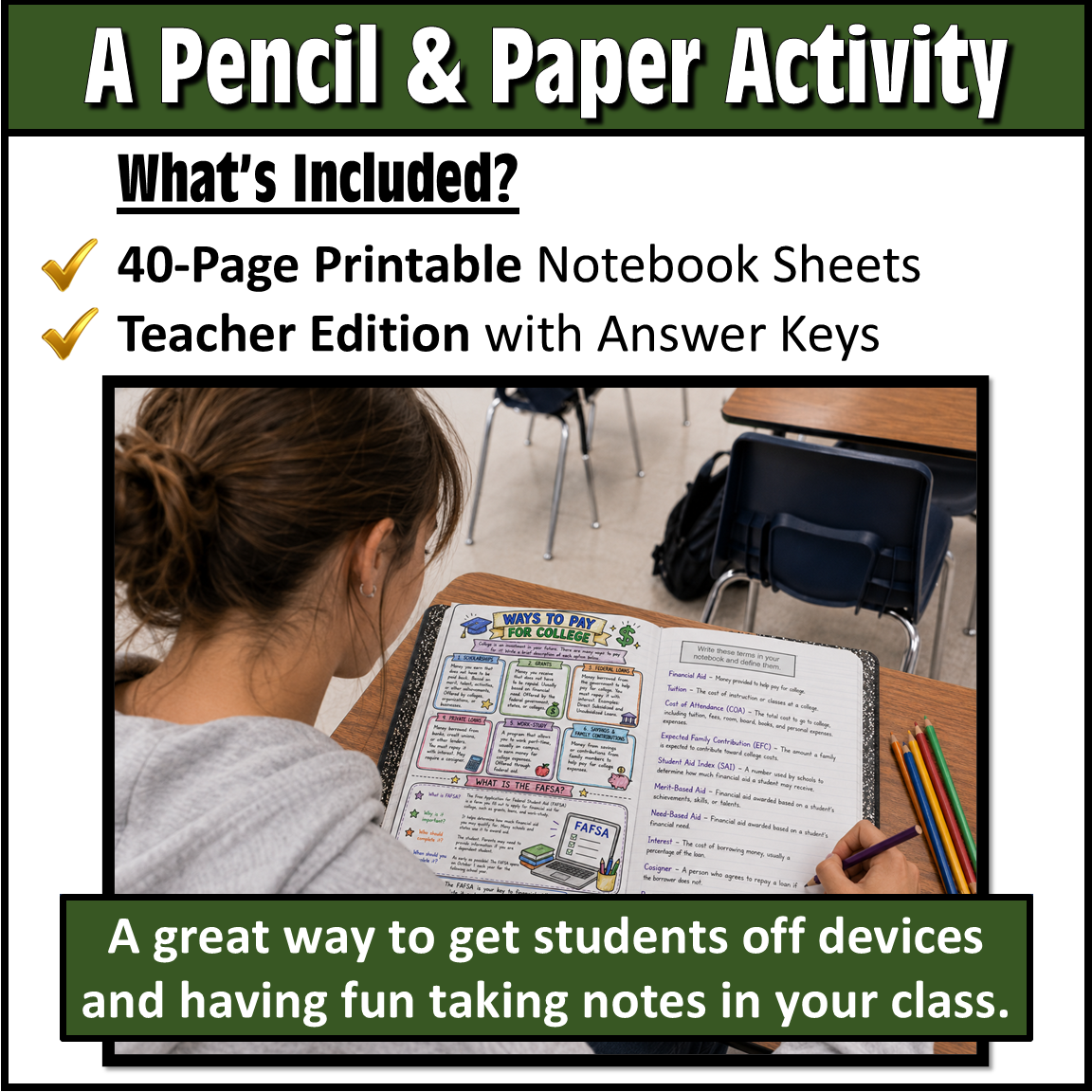
Instead of simply copying definitions or watching presentations, students create a personalized Personal Finance notebook that becomes both a study guide and a valuable classroom reference. Students can color the pages, tape or glue them into a composition notebook, record vocabulary definitions, and respond to open-ended questions that require them to apply what they have learned to realistic financial situations.
This 40-page printable notebook is designed for middle school and high school students and works well in Personal Finance, Financial Literacy, Consumer Economics, Business Education, Career Readiness, Family and Consumer Science, and homeschool courses. A completed Teacher Edition, teacher instructions, grading suggestions, bell ringers, and two notebook cover options are also included.
✅ Perfect for 6th, 7th, 8th, 9th, 10th, 11th, and 12th grades (Middle School & High School)
Why Teachers Will ❤️ This Interactive Notebook
✔️ NO PREP — Simply print and use
✔️ Helps students organize Personal Finance course content
✔️ Provides a meaningful device-free learning option
✔️ Encourages writing, reflection, and active note-taking
✔️ Reinforces essential Personal Finance and Financial Literacy vocabulary
✔️ Includes real-world critical-thinking questions
✔️ Includes bell ringer and exit ticket questions
✔️ Works as guided notes, independent practice, review, or assessment
✔️ Creates a student-made Personal Finance study guide
✔️ Includes a completed Teacher Edition with answers for the content pages
✔️ Includes teacher instructions and grading suggestions
✔️ Includes fun Personal Finance stickers for decorating notebook covers
✔️ Great for in-person learning, homeschool, review days, and substitute plans
What’s Included❓
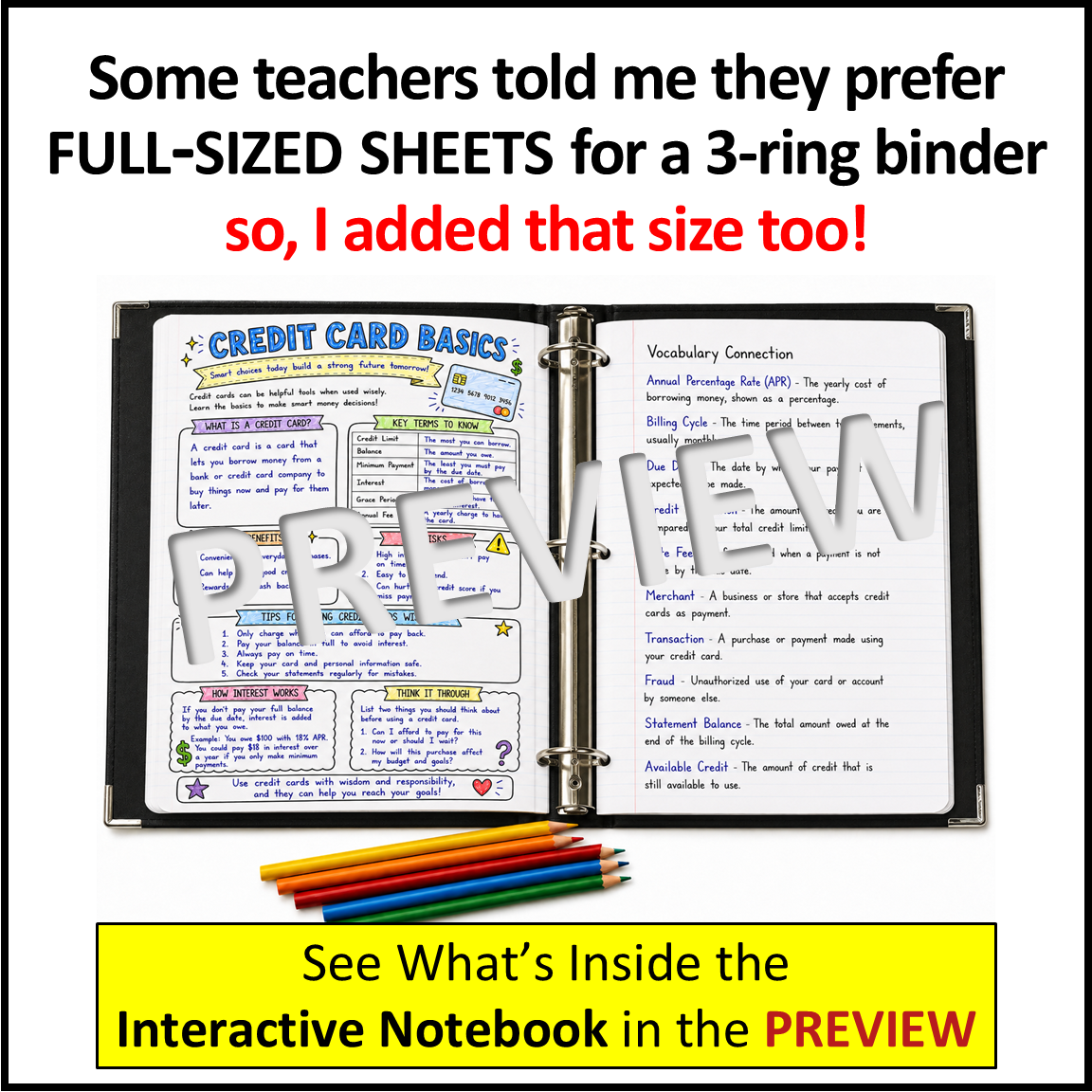
The resource includes pages designed for a traditional interactive notebook as well as full-size 8.5″ × 11″ sheets for teachers who prefer students to keep their work in a 3-ring binder.
🎯 How the Interactive Notebook Works
Each major Personal Finance topic follows a consistent three-part format:
1. Content Page
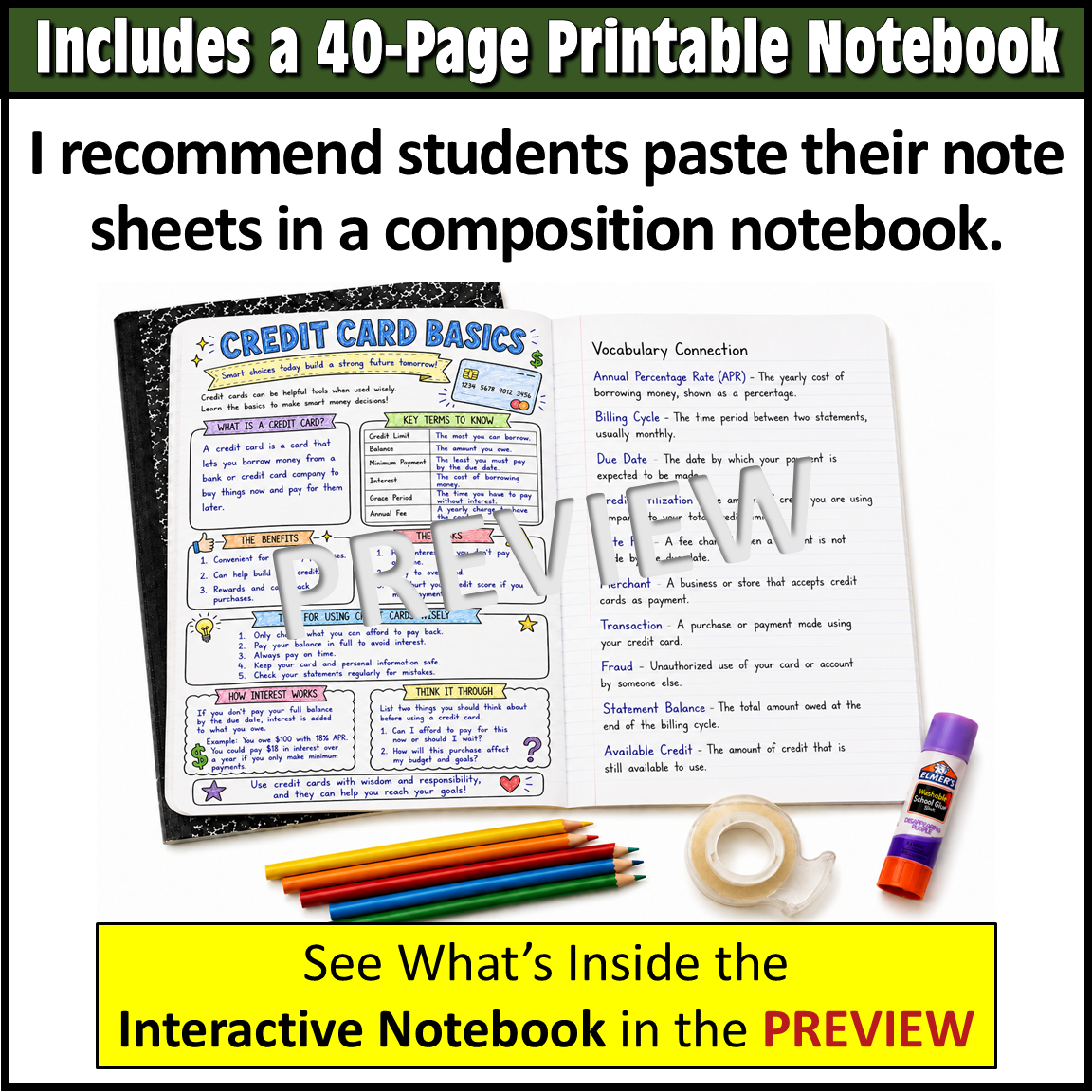
Students complete an illustrated content page that summarizes the major financial concepts. The page can be colored, completed, and attached to a composition notebook using tape or a glue stick. I recommend projecting the completed Teacher Version so students can accurately complete their notes while you teach or discuss the topic. This keeps students organized and provides them with accurate reference notes throughout the course.
2. Vocabulary Connection
Students write the accompanying Personal Finance vocabulary terms on the opposite notebook page and define or explain each term. This helps students build a strong working financial vocabulary while connecting important terminology to the lesson content.
3. Critical-Thinking Questions
Students apply what they have learned through open-ended questions, financial scenarios, comparisons, personal reflections, and real-world applications.
Because the critical-thinking questions are open-ended and student responses will vary, answer keys are not included for those subjective responses. The Teacher Edition includes completed answers for the instructional content pages.
🎯 What Class Is This For?
🧩 Student Activity Highlights
✔️ Create and evaluate personal financial goals
✔️ Explore factors that influence wages
✔️ Compare education and career pathways
✔️ Identify different sources and types of income
✔️ Compare budgeting methods
✔️ Evaluate bank account options
✔️ Practice check-writing concepts
✔️ Calculate and analyze net worth
✔️ Examine common taxes and tax forms
✔️ Interpret paychecks and payroll deductions
✔️ Compare savings and investment choices
✔️ Analyze different types of loans
✔️ Examine responsible credit card use
✔️ Explore credit scores and credit reports
✔️ Evaluate insurance options
✔️ Compare ways to pay for college
✔️ Identify strategies for preventing identity theft
✔️ Respond to realistic Personal Finance scenarios
✔️ Build a personalized Financial Literacy study guide
📌 Bell Ringers and Exit Tickets
The Teacher Edition includes 140 Personal Finance bell ringer and exit ticket questions covering the notebook topics.
Teachers can:
📥 File Type: Printable Google Slides files (or convert to pdf or PowerPoint).
Students may use the pages in:
✔️ A composition notebook
OR
✔️ A 3-ring binder using the included full-size sheets
It is not an editable digital notebook.
⭐Perfect for Device-Free Days⭐
Students can attach the pages to a composition notebook using tape or glue sticks. Students write the accompanying vocabulary terms and definitions directly on the notebook pages opposite each content sheet.
Personal Finance/Financial Literacy Topics Covered:
This interactive notebook takes students through the financial life cycle—from education, careers, income, and budgeting to banking, taxes, credit, college costs, insurance, saving, investing, and protecting their financial identity. Its emphasis is strongly practical: students repeatedly compare options, evaluate risks and benefits, make hypothetical financial decisions, and explain their reasoning.
🎯 This Personal Finance Interactive Notebook gives students a creative and structured way to interact with Financial Literacy content while building vocabulary, critical-thinking skills, financial knowledge, and responsible money-management habits. By the end of the course, students will have created a personalized Personal Finance reference notebook they can use to review concepts, prepare for assessments, and connect classroom learning to real-world financial decisions.
This Personal Finance Interactive Notebook is a great companion resource for my Personal Finance and Financial Literacy curriculum.
Only logged in customers who have purchased this product may leave a review.





Reviews
There are no reviews yet.